I Thought I was in the Film Business
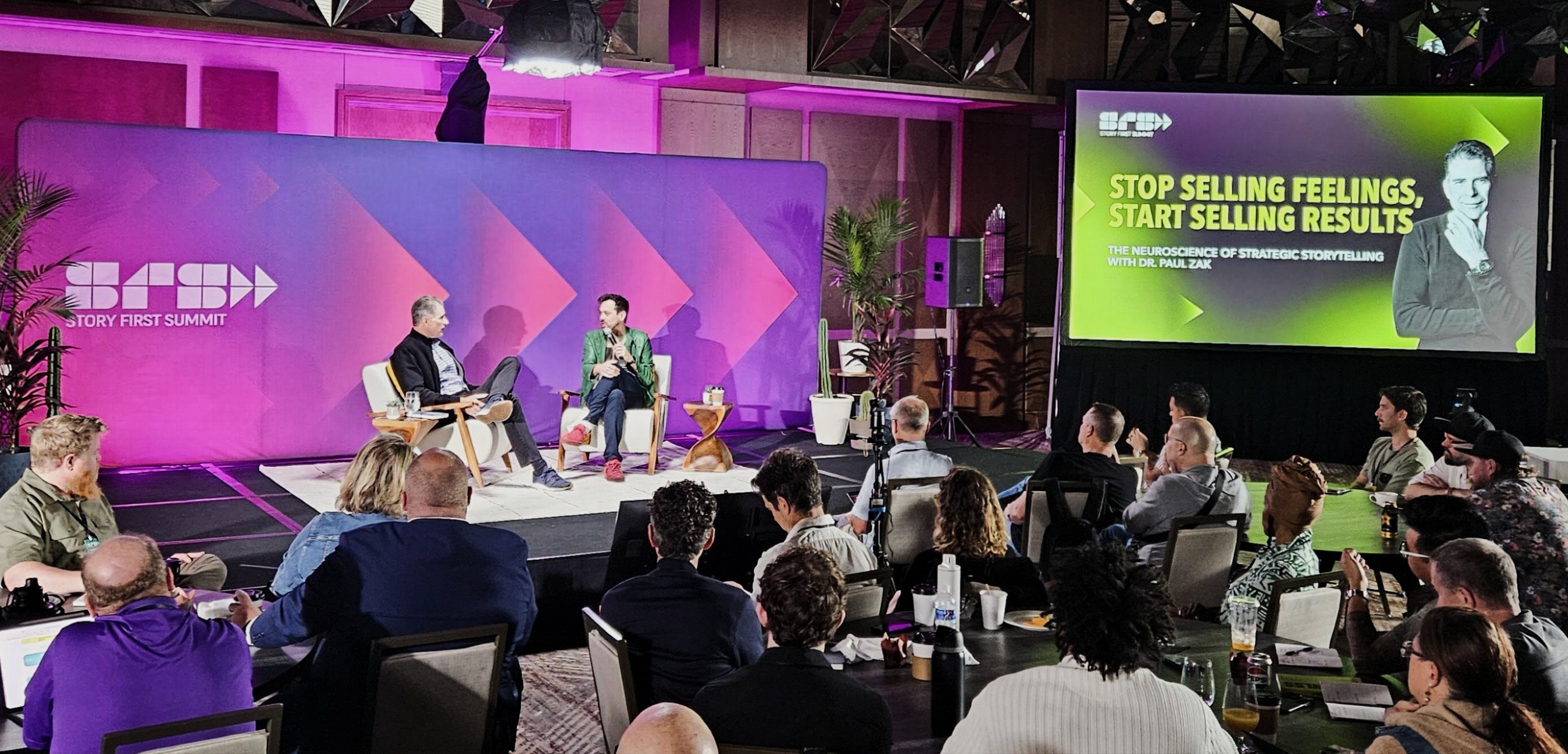
Last year I found myself in Austin, Texas, attending a storytelling conference.
I went because I wanted to make better films, which seemed a perfectly reasonable ambition. If I could improve my interviewing, my editing and my understanding of story, surely I'd produce better work for my clients? Work they’d value more. It wasn’t that people didn’t like what I had done, quite the contrary but we’re often our own worst critic and I wanted to like my work better – which of course would mean clients and their clients would also like it better.
Then one speaker quietly dismantled that assumption.
Paul Zak is a neuroeconomist/neuroscientist whose research explores how stories influence human behaviour and the neurochemistry of trust and empathy. During his presentation he made an observation that has stayed with me ever since.
The correlation between liking a piece of content and taking action because of that content is effectively ZERO!
I remember sitting there thinking I'd just spent years measuring the wrong thing. Like most filmmakers, I'd been asking questions such as:
* Did people enjoy the film?
* Did it look beautiful?
They seemed like sensible measures of success, but on the flight home I now found myself thinking about different questions – ones I was already asking but which now carried a far greater weight.
* What job is a film actually supposed to do?
* How did it make the audience feel?
That one statement turned out to be far more useful than anything else I learned that week – by a country mile. If a charity commissions a film because donations have plateaued, admiration isn't the objective. If a B Corp™ wants to recruit people who share its values, the objective isn't simply to tell its story. If an organisation wants volunteers, funding, policy change or cultural change, then the communication has a job beyond being watched.
That doesn't make filmmaking any less important. Far from it. It means the craft is serving something larger.
Looking back, I realise I'd been describing myself as a filmmaker because that was the visible part of my work.
The camera. The interviews. The edit. The colour grading. The music.
They're all real. They're all important. They're simply not the whole story.
Today, I spend more time helping organisations work out what they're trying to change than I do deciding where to put a camera.
Sometimes the biggest challenge isn't creating content at all. It's discovering the story that needs telling and understanding the role that communication needs to play.
That's why I no longer think of myself as simply being in the film business. I'm interested in helping organisations create change. Film just happens to be one of the tools.