
You’ve put time, money and care into telling people about your organisation. The response is encouraging. People say they love the film, the post or the story. Perhaps they share it, too.
But has anyone done what you hoped they would do?
That question sits at the heart of effective brand storytelling. If you want someone to donate, support your work, make an enquiry or put their trust in your organisation, appreciation alone doesn’t tell you whether your story has achieved its purpose.
In my work as a filmmaker and Narrative Architect, I approach this through the people behind an organisation: what they want, why they want it, and what stands in their way. Giving an audience someone to connect with helps them understand the purpose of the organisation through a human experience.
Before you decide how to tell that story, though, you need to discover it.
Be clear about what you want your story to achieve
I use the term “the admiration trap” to describe what happens when an organisation mistakes people liking its content for the outcome it produced that content to achieve.
Positive feedback feels good. Of course it does. When you’ve invested in something, hearing that people enjoyed it is reassuring. But if your film was intended to encourage donations, compliments and donations are different measures.
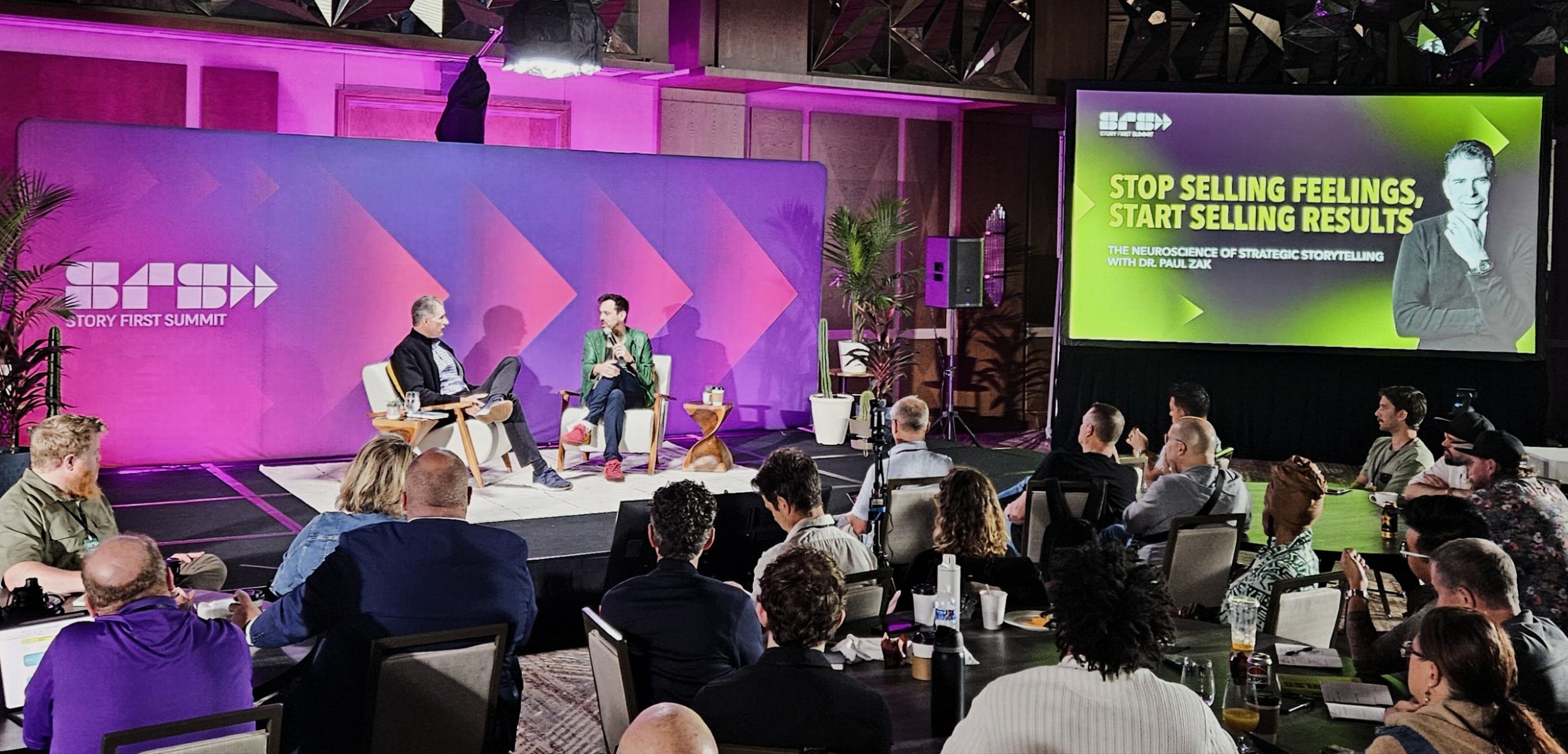
Neuroeconomist Paul Zak has discussed finding no correlation between self-reported liking and his measure of immersion. That is a more specific finding than saying liking never leads to action, but it raises a useful challenge: asking whether people liked something may tell us less than we hope about its effectiveness. Roger Dooley
Before developing a brand story, ask yourself what you hope someone will do after experiencing it. Be specific enough that you can recognise the response.
For a charity, that might be offering practical support. For a business, it might be starting a conversation about working together. A film accompanying a funding bid may help someone understand the people who would be entrusted with that funding.
That purpose gives your story direction. It also gives you a better question to ask afterwards than, “Did people like it?”
Give your audience a human being to connect with
An organisation can describe its values, explain its services and list its achievements. Those things can be useful, but I believe we respond more readily when we encounter the humanity behind them.
Someone trying to achieve something gives us a way into the organisation’s work. We begin to understand the situation through their experience, rather than having to interpret everything from the outside.
There is research behind the broader idea of becoming absorbed in a story. Psychologists Melanie Green and Timothy Brock described this as narrative transportation: an experience involving attention, emotion and mental imagery. Their experiments found that greater transportation could influence beliefs and evaluations of the people in a story. pubmed.ncbi.nlm.nih.gov
The way I think about it in practice is that a story can help us find ourselves in someone else’s shoes. We start to understand what they are facing and why it means so much to them.
That doesn’t guarantee a donation, an enquiry or a decision. It creates an opportunity for a deeper connection, through which the organisation’s work becomes easier to understand.
Let the story move you before you move the story
If you asked me which story your organisation should tell, I would want to have some conversations before offering an answer.
I have a saying: “Let the story move you before you move the story.”
That is the principle behind what I call storyfinding. It has something in common with the research a journalist does before writing an article. You talk to people, explore their experiences and listen for stories that carry resonance within the context of what you are trying to achieve.
It requires a willingness to discover something you hadn’t anticipated.
If you enter every conversation with a finished message and a fixed idea of what someone should say, you leave little room to hear what makes their experience compelling. You may come away with the words you wanted while overlooking the story they could have shared.
For me, the person at the centre of that discovery is the Heart character.
Find the Heart character through Uniqueness, Desire and Motivation
The Heart character is the person we connect with as the story unfolds. In my approach to brand storytelling, I look for three things: Uniqueness, Desire and Motivation.
These give us a practical way to explore why someone draws our attention and why we might stay with their story.
Uniqueness: what draws us towards this person?
There is something about the person that catches our attention.
It might be a young woman with cerebral palsy doing some boxing, or a sassy, streetwise woman running a drop-in centre. It might come through in how someone looks, sounds or behaves, or in the way they approach a situation.
Uniqueness doesn’t require someone to be an accomplished public speaker. Often, what draws us towards them is a quality that would disappear if we tried to make them sound more polished or corporate.
The task is to notice that quality and allow it to come through.
Desire: what do they really want?
Desire is the strongest element of the three.
What does this person want enough to keep going when something gets in their way? What are they trying to achieve, protect or change?
My rule of thumb is that an audience won’t want to stay with the story any more than the Heart character wants what they are pursuing.
If the person can comfortably abandon their goal at the first difficulty, it becomes harder for us to invest in whether they succeed.
Motivation: why do they want it?
Motivation helps us understand the desire.
Two people can want exactly the same thing for very different reasons. Once we understand the reason, an apparently ordinary task can become deeply involving.
A simple example I often use is going out to get some milk.
What a trip to buy milk can teach us about storytelling
Imagine a woman coming downstairs to make a coffee. She opens the fridge and discovers there isn’t enough milk.
She picks up the car keys. It’s raining outside, and when she reaches the car, she finds a flat tyre. She comes back indoors, puts the kettle on and has a cup of tea instead.
There is a goal and an obstacle, but very little is at stake. She fancied a coffee and was happy to have something else.
Now imagine a little girl opening the same fridge.
She is making a cake for her beloved great aunt’s 80th birthday. This aunt did something wonderful for her, and making the cake is the girl’s way of showing how much she loves her.
There isn’t enough milk.
She and her mum go outside. It’s raining, and the car has a flat tyre.
I can feel the tension rising even as I describe it. How are they going to get the milk? Will she be able to finish the cake?
The practical problem is the same, but our investment has changed because we understand the girl’s desire and motivation.
When you discover that combination in a real person’s experience, that’s your gold dust.
Look for the humanity in the work you already do
You don’t have to invent a dramatic situation to make an organisation’s story compelling. Storyfinding is about discovering what people are already experiencing.
In a conversation, you might explore:
- What are you trying to achieve?
- Why is that important to you personally?
- What makes it difficult?
- What happened that made you want to do something about it?
- What would achieving it mean to you?
These are starting points. The value comes from listening to the answers and being willing to follow something unexpected.
You may find that the story lives in an experience you had previously passed over because it seemed ordinary. To the person living it, there may be a great deal at stake.
Judge your brand story by the response it helps create
With the Hereford Food Bank film, the response included practical offers of help, including a van and flooring. Those offers gave us something tangible beyond positive feedback.
A film for Megan Baker House was also used in a successful funding bid. I wouldn’t suggest that a film alone determines a funding decision, but it can help people understand the human beings behind an application and the work they are asking someone to support.
That is where I see the value of storytelling: helping people understand who is involved, what they are trying to achieve and why they care so deeply about it.
Start with a conversation
To tell your brand story effectively, begin with a clear purpose and give yourself time to discover the people whose experiences bring that purpose to life.
Listen for what draws you towards them, what they strongly desire and why they want it. Then consider how their story could help your audience understand your organisation and take a meaningful next step.
Let the story move you before you move the story.
If you would like help discovering the human stories within your organisation and understanding how they can support what you are trying to achieve, get in touch with Moonrise Media. We can start with a conversation about your work and the people at its heart.